|
|
|
The following is a mirrored copy of a very helpful starter clutch rebuild page. It is not my creation.
I would be grateful if you considered purchasing one of my recipes
Key Lime Pie Recipe
Bayfield Waffles
| Return To MagSab High Tech & Customization Site Main Page |
Starter Clutch |
Background:
The starting system of the V-4s consists of a starter and a one way starter
clutch. The starter clutch is a geared assembly which is connected directly to
the crankshaft by a gear mounted on the clutch. The starter clutch is always
connected to both the starter and the clutch gear, and its one way operation prevents
engagement when the engine is running. Numerous Magna and Sabre owners have
experienced a difficulty with the starter clutch. It first starts as a 'slipping' or
grinding every once and a while, then it happens more often, and eventually it leads to
failure.
This is a classic (chronic) problem with the Magnas and Sabres, and it has happened to me twice. The problem originates in the one-way starter clutch. This one way operation is controlled by three little 'flattened' balls (stubby cylinders, really) , which are pressed against the round starter clutch surface with springs and contact 'brushes.' What happens is that the springs are about the quality of ballpoint pen springs, and after a while lose their resiliency. This causes a lessening of the pressure on the 'balls' and clutch, which causes it to slip. Once it starts slipping, it scores the inside surface of the gear assembly, forcing replacement of the gear as well as the brushes, balls and springs. If it is only slipping once and a while,you can assume that it hasn't done too much damage yet. Replacing those crappy springs will probably cure it. You can order the springs separately from a dealer, but that will only solve the problem for a short while. Better springs are the answer. The springs are a little bigger than those you would find in a pen, and about the same quality. The springs are about 11/64" diameter and when at 'rest' are .825" long.
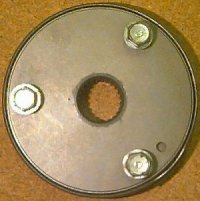
Figure 1 shows the complete starter clutch
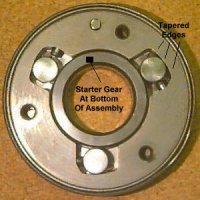
assembly. Once the three bolts are removed, and the cover plate comes off, the
assembly in figure 2 is revealed. Notice in figure 2 that the 'starter gear'
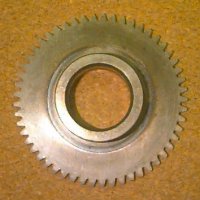
is highlighted. This gear can be seen separated in figure 3.
|
|
|
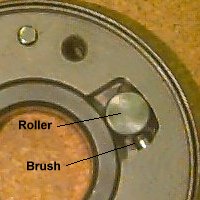 This is a close-up of the roller and brush section. The brush is
supposed to push the ball into the tapered end of the channel. When the gear is then
turned counterclockwise with respect to the housing, the roller is then pushed further
into the narrow end of the channel, effectively 'binding' the housing to the gear.
This is the one way action. When the gear is turned clockwise with respect to the
housing, the roller goes into the 'wide' part of the tapered channel, and is free to
rotate. Therefore, the assembly is free to rotate in one direction, and not free in
the other. It can be seen the important role the spring plays in this
assembly. It must push the roller constantly. The spring must operate at high
temperatures and high rpm's. When the spring fails, the roller is free to move back
& forth in the assembly, sometimes catching, sometimes not. When it catches or
slips, it may score the smooth surface of the starter gear. When this happens, the
gear is rendered useless, since it is no longer a smooth surface for the brushes to
contact.
This is a close-up of the roller and brush section. The brush is
supposed to push the ball into the tapered end of the channel. When the gear is then
turned counterclockwise with respect to the housing, the roller is then pushed further
into the narrow end of the channel, effectively 'binding' the housing to the gear.
This is the one way action. When the gear is turned clockwise with respect to the
housing, the roller goes into the 'wide' part of the tapered channel, and is free to
rotate. Therefore, the assembly is free to rotate in one direction, and not free in
the other. It can be seen the important role the spring plays in this
assembly. It must push the roller constantly. The spring must operate at high
temperatures and high rpm's. When the spring fails, the roller is free to move back
& forth in the assembly, sometimes catching, sometimes not. When it catches or
slips, it may score the smooth surface of the starter gear. When this happens, the
gear is rendered useless, since it is no longer a smooth surface for the brushes to
contact.
|
SPRING CHARACTERISTICS
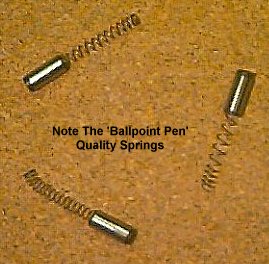
Unsprung Length: 1.70" Wire Diameter: .012" 'Natural' Compressed Length: 1.178" Diameter: .172" or approx. 11/64" Brush Inner Diameter .187" |
 |
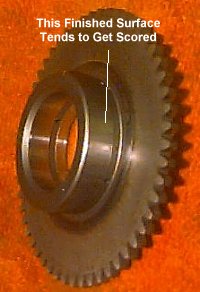
The photo on the left shows a side view of the starter gear. The surface shown comes in contact with the rollers. The rollers are supposed to be riding on the gear all the time. When the spring lets loose, it causes the rollers to bang against the starter gear surface, causing damage to the machined surface.
On the right is a view of the springs, with the brushes that fit over them. Note the quality of the springs. Look familiar? Open a ballpoint pen and its deja vu! I have found a replacement spring. The specific measurements are shown above. See the FAQ below for details.
FAQ
Will the problem just go away?
No! The problem will get
worse and worse, and finally the starter will do nothing but whine.
What if I just change
the springs, and use the stock Honda replacements?
This may work for a time, but it is a gamble. Read on for other related
questions.
Does the 'slipping' have
anything to do with synthetic oil?
No!
If I put in better springs,
can I get away with keeping the other components?
That depends. How bad is the starter gear surface?
Is it scored? It is the only item which is costly, so it may be worth
keeping. This is a judgement call, but I personally would replace it at the first
sign of trouble. The rollers and brushes are less than $5 each or so. It is
worth replacing them when you have the engine apart.
What other springs can
I use?
McMaster Carr has a variety of
stainless steel springs. Unfortunately, they do not have the exact diameter, so it
is necessary to use a smaller diameter. I used a .125 diameter stainless steel
spring, located on page 2904 of their catalog. The type 302 stainless steel spring,
.125" diameter, P/N 9663K52. There are a total of four different springs
outlined for that size, and they either one would work just as well. Make
sure the tension is not to great. Note that the page number on McMaster Carr may be
wrong, as they update their catalog periodically. Also, the springs come
in packs of 5 springs, each approximately 22" long. The spring must be
cut to the proper length before insertion. Yes, you will have to cut them yourself.
How many other
SabMaggers have 'upgraded' their springs to the McMaster Carr ones?
At least three other SabMaggers, not including myself, (1998) have
successfully used these springs. The first guinea pig (after myself) was Joel H. on
his 1982 V45. He has had no problems since. At one time, I had a limited
supply of springs that I sent out free.
Will this work on the
other members of the V-4 family?
Yes, the starter clutch is similar, if not exactly the same in
most of the V-4 engines.
Should I locktite the
starter clutch bolts?
Yes! I use Locktite 242 (blue)